$24M for climate-neutral flight: Metafuels brings synthetic aviation fuel to market at commercial scale
Zurich, Switzerland – February 2026 – Global sustainable aviation fuel production must increase more than 150-fold by 2050 to meet projected aviation demand – a scale that bio-based fuels alone cannot deliver. Metafuels, a Swiss aviation technology company, is addressing this challenge with a synthetic methanol-to-jet pathway designed to unlock the volumes, economics, and carbon performance aviation will need over the long term. Today, the company announced a $24 million funding round that brings its aerobrew product to market.
The round is led by UVC Partners, with strong participation from existing investors including Energy Impact Partners (EIP), Contrarian Ventures, RockCreek, Verve Ventures and Fortescue. The financing underscores investor confidence in Metafuels’ move from breakthrough technology to first-of-a-kind commercial plants and a repeatable industrial model.
The new capital will drive the realisation of Metafuels’ commercial projects – advancing flagship facilities toward implementation and final investment decisions, while laying the strong engineering, delivery, and organisational foundations needed for multi-plant deployment across Europe as SAF mandates gain momentum. This includes progressing facilities through front-end engineering and design (FEED), preparing projects for final investment decision (FID), and building the organisational, engineering and delivery capabilities required for multi-plant deployment - as SAF mandates expand across Europe.
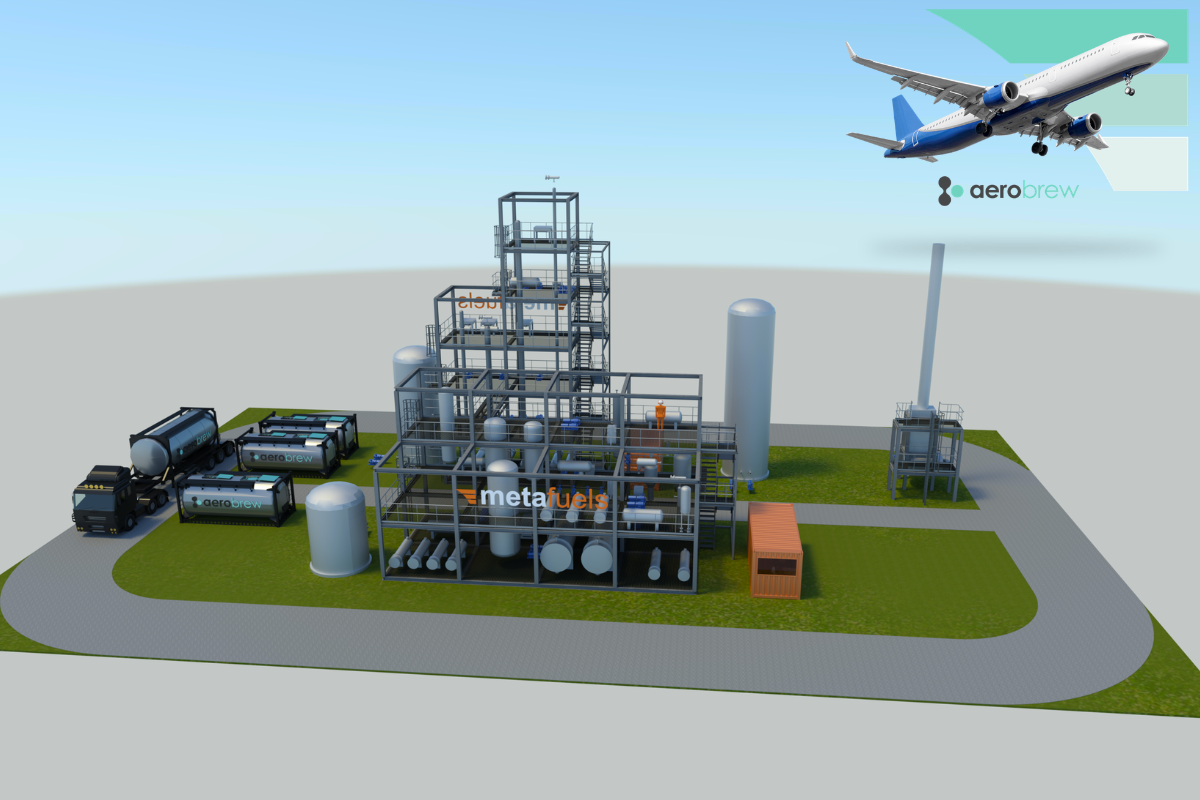
Metafuels is preparing its methanol-to-jet demonstration plant at the Paul Scherrer Institute (PSI) in Switzerland for start-up, while advancing Turbe, its first commercial e-SAF facility in the Port of Rotterdam. Turbe is intended to be the initial commercial deployment of aerobrew and a blueprint for future large-scale plants aligned with ReFuelEU Aviation and emerging global mandates from 2030 onward.
Decarbonising the aviation sector remains a critical challenge. The sector accounts for over 2% of global CO₂ emissions – some 800 million tonnes. When accounting for additional greenhouse gases and complex climate co-factors resulting from the nature and altitude of emissions, the sector’s total contribution to global warming rises to approximately 3.5%.
Methanol-to-jet: a pathway designed for scale
Metafuels focuses on the methanol-to-jet route to sustainable aviation fuel, a synthetic pathway that converts renewable methanol into drop-in jet fuel. Renewable methanol can be produced either from sustainable biomass or from renewable electricity, green hydrogen and captured carbon, making it one of the most scalable intermediates available for aviation decarbonisation.
Metafuels’ differentiator is cost leadership, achieved through the ability to convert e-methanol into e-SAF with a significantly higher yield, ensuring a more efficient and cost-effective process. Metafuels’ signature e-SAF, aerobrew, can replace conventional kerosene regardless of the size, type of aircraft, and short-haul or long-haul flights. Metafuels’ fuels are fully compatible with existing aircraft, engines and airport infrastructure.
Compared with today’s dominant SAF pathway – hydroprocessed esters and fatty acids (HEFA), which relies on constrained supplies of waste oils and fats – methanol-based e-SAF is not limited by feedstock availability. As a result, methanol-to-jet is widely regarded as a critical pathway for meeting long-term SAF demand, particularly as blending mandates rise sharply from 2030 onward.
“If sustainable aviation fuel is to become a true alternative to fossil jet fuel, it has to work at an industrial scale and competitive cost,” said Saurabh Kapoor, Chief Executive Officer. “Methanol-to-jet makes that possible. With aerobrew, we are building a pathway that allows airlines to decarbonise without changing how they operate – and that has the potential to fundamentally reshape the future of flight. This round is about execution. We are moving from demonstrating our technology to deploying it at an industrial scale."
Industrial readiness and regulatory alignment
This funding round comes at a critical point for the e-SAF sector. Regulatory frameworks such as ReFuelEU Aviation are creating firm, long-term demand signals, while the ASTM accreditation process for the methanol-to-jet pathway is advancing toward completion, with approval expected in early 2026. Accreditation is a prerequisite for large-scale commercial offtake and a key enabler for investment into synthetic fuel production.
As outlined in Metafuels’ recently published white paper, Clearing the Runway for SAF, global SAF production must increase by more than 150-fold by 2050 to meet projected aviation demand. This scale cannot be delivered through bio-based fuels alone, and synthetic pathways such as methanol-to-jet are required to provide the volumes, cost reductions and carbon performance needed over the long term.
With projects progressing in Switzerland, Denmark and the Netherlands, Metafuels is positioned to support the next phase of SAF deployment as regulatory requirements and market demand accelerate through the 2030s.
“This investment is about promoting the implementation of this unique project and enabling the use of airbrew. When sustainable fuel becomes available on a large scale, it will no longer be a limitation but will become infrastructure,” said Johannes von Borries, Managing Partner at UVC Partners. “Metafuels has the potential to drive that shift – fundamentally changing how aviation grows and how people think about flying.”
About Metafuels
Metafuels is a Zurich-based aviation technology company developing proprietary sustainable fuel technologies, with an initial focus on synthetic aviation fuel. Metafuels’ aerobrew process converts renewable methanol into jet fuel with ultra-high carbon efficiency, delivering up to 90% lower lifecycle emissions than fossil kerosene. The company’s fuels are fully compatible with existing aircraft and airport infrastructure, providing a direct, scalable pathway to aviation decarbonisation.
For more information, visit metafuels.ch
About UVC Partners
UVC Partners is a leading venture capital firm investing in European B2B tech startups, with offices in Munich and Berlin. Managing over €600 million in assets, UVC Partners typically invests between €1million and €10 million initially, with up to €30 million per startup, focusing on DeepTech, ClimateTech, Mobility, and Software/AI. As an independent partner of UnternehmerTUM – Europe’s leading startup ecosystem – UVC Partners has unique access to proprietary deal flow, over 1,000 corporates and SMEs, and top talent from the Technical University of Munich, one of Europe’s leading technical universities. UVC Partners' portfolio includes Flix, Isar Aerospace, planqc, Proxima Fusion, Reverion, Tacto, TWAICE, DeepDrive, STABL, and many more. All portfolio companies and founders benefit from the team’s extensive investment and exit experience, its ability to build sustainable industry leaders, and theUnternehmerTUM network – particularly when it comes to accelerating market entry.
Website: www.uvcpartners.com
